So to kick off what is the second part in this series exploring Jungle I contacted Owen Hatherley. A fount of architectural wisdom and expert on Modernism; this was to understand his perspective on the relation between music, drum ’n’ bass and cityscapes. Having seen that he was a fan of Eddie Otchere’s Junglist, it seemed fitting too.
Owen needs little introduction regarding his background, but I will mention the immense impact his book ‘The New Ruins of Great Britain’ had on me. As a general explanation, Owen remains sympathetic to Modernist architecture, particularly post-war design, as it was a time in which architecture remained truly experimental and oriented towards bettering the lives of the working class. And yet, the period has received plenty of disdain and demolition from various detractors, unaware or disgusted of what it represented and envisaged. Thank you to Owen for his insight on British architecture.
Me: The first question I wanted to ask is a much more general one. What do you feel today is the relationship between the musical stagnancy that exists, in pop music and something such as the Hardcore Continuum, and the architectural stagnancy we see today, as explored in much of your writing?
Owen: I think one can see infinities between music, electronic music, pop etc and architecture. But they really stay at that level, as you are dealing with one of the fastest art-forms and then one of the slowest. You know a building takes at best, at the very fastest, a year or two to build. Frequently it can take a decade to construct. In popular music, a decade is a very long time indeed, even now. What was happening 10 years ago is very different to what is happening now. The temporalities are just so different. I don’t think you can compare their level of speed or innovation or anything like that because it often doesn’t really work. And also the way that their internal processes of innovation can change are just really very different. There has never been a moment in architecture, even at its very fastest, where you would see a change that you would get in the mid-sixties or the early-90s, where within six months a scene would be completely transformed. Thats impossible in architecture. So i don’t think you can really run them together in that way. I do think there is a question about environments however. To get a sense of that process of non-synchronicity, I don’t think there is any 1960s pop records that mention new-towns or tower blocks. At the time in which they are being built, no one is talking about them, its just not there. By the late-70s, by which that stuff was already incredibly unfashionable architecturally, and it had been standing for a while, it then features constantly in Punk and Post-Punk. So you have got these totally different streams that are happening, in which for sure, the speed of innovation slowed down in both. But at differernt times, in different ways and in different speeds.
Me: That makes sense. I’m aware you spoke about Hulme Crescent in New Ruins of Great Britain and how that fostered the punk and post-punk scene in Manchester. Do you feel as if the music produced in the ’60s, ’70s, ’80s and ’90s had a direct or even quiet relation with the modernist architecture produced in post-war Britain and how do you think this best manifested?
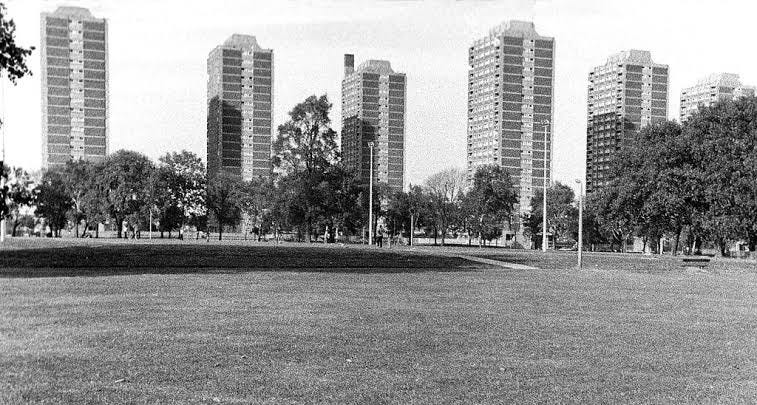
Owen: Yes absolutely. There is all sorts of times in which there is a relation, with the aforementioned provisoe that its usually not happening at the same-time. Hulme is a rather interesting example of that. The thing that makes it a centre of pop-music is its failure as a kind of ordinary housing. By the time its less than 10 years old, Manchester city council basically stop housing families there. It becomes incredibly hard to let, it becomes centrally squatted and the council were basicallly giving them away, oftentimes to people who were in the music scene. I don’t think that involves everyone that lives in Hulme crescent. Im sure there are lots of people that had very little to do with it. But you had this real disproportionate concentration. But the reason that was able to happen was because it wasn’t a successful example of social housing. There are other times in which there might be more successful or mundane social housing that guest feature in music. For instance, the guy from Hefner that did an album on Harlow New Town. It [Modernism] kind of turns up later and in Ghost-box as an object of nostalgia. I think often from people kind of raised in it, or have it at a great historical distance. Then the other thing I think is people starting to register or talk about living in tower blocks. The Clash is obviously the very big example. Despite the fact that Joe Strummer was extremely posh, Mick Jones was not and lived in one of the big high-rises near the West-way that looked over Harrow road. So that turns up loads in early clash Records. And you can kind of go through a lot of post-punk records and find various references to different Modernist housing, Modernist Housing that had almost all been built by the end of the 1960s, that is very seldom being built in the seventies.
By the end of the 1970s post-modernism had already won the argument that modernism was over. Because of the fact that it becomes housing that is very very cheap, you have it being kind of connected with young people, as often they don’t have much money, at a point when council housing was very hard to let. It was being given away a lot, particularly to students and such things. Pulps various records touch on council housing. They lived in council housing in London, after being students, rather than in most cases in Sheffield. So in sheffield it was a thing that another group of people lived in. And of course when you are dealing with the hardcore continuum, you are dealing with a multicultural working class, that in a lot of cases are living in modernist housing. Although, its [the Hardcore Continuum] a lot more suburban than people give it credit for. Theres a reason the record label is called Suburban Base. Its very big around the M25, around many of the new-towns and so forth. Its not like everyone there is living in high-rises in Hackney. Although a lot of people are. And high-rises of course are a very good place to put pirate radio masts. Thats why there has been so many pirate radio stations placed in tower blocks. So thats just a backdrop a lot of the time, in Grime videos it was always a backdrop. Sometimes its a backdrop where somebody might actually live like Crossways estate in Bow because a lot of people involved in early Grime like Roll Deep and Ruff Sqwad had always lived in the estate. But then later it sort of just becomes a concrete backdrop. Skepta’s video is set in the Barbican. And of course if anyone knows their architectural history, the Barbican is… you know, even skepta would struggle to afford a flat in those towers now. It does the grime video thing of, we are in the mean concrete streets, here we are.
Me: Yes! I suppose with the architecture being produced today, do you feel as if these new awful clad panelled high-rises you see on the approach to paddington on the train, will be the places of music production in 20 or 30 years time?
Owen: Yeah, I mean I have to sort of plead the fifth on this, I don’t particularly know too much about new music. When music has turned up in recent years environments, it seems to be either in Grime and then Drill, where it turns up as a kind of like, we live in the slums and they are made of concrete. Or its a kind of a fantasy futurist city that features a lot in vaporwave. You know the kind of environments that are a sort of permanent japan circa-1982. Thats where that is. The new environments, it is tough to say. But, how one would connect them to those two things is quite interesting. A lot of those very very bleak student high-rise flats there are so much of arguably serve a similar purpose to what Modernist council tower-blocks were to post-punk in the late ’70s. A very alienating environment. Because they are… extraordinarily alienating. Beside how cheaply mass produced their construction quality is, they’re also very small flats, very enclosed, discourage leaving the complex a lot of the time. In the pandemic they were frequently closed off. So you know maybe those brightly coloured student flats will turn up in pop-culture in some way, it would be interesting to see that happen. And I think a main experience for a lot of people in London, is poor quality rental housing, which is usually not in new buildings. It is usually in Victorian stock that has been subdivided. That is the basic environment for downwardly mobile youth in London. They don’t live in those new high-rises by-in-large. And even in the student ones, its generally more affluent students and Chinese students that live in them. But they are all around, so I can evisage them certainly being in that new music environment.
Politically, I’m obviously very sympathetic to that period of architecture [Modernism], but the people who have made it a part of their music generally are not. Which is one reason why I sort of fasten onto something like Pulp or the Human League because they actually seemed to like Modernism. They liked living in Modern architecture. Which is interesting because it is the exception to the rule. Most of the time it is treated as a very alienating environment. But this also drags onto another question, which is one that Journalism on music nowadays focuses on a lot, can people afford to make culture or music given how expensive living and housing is? And again, it seems to happen but yeah it is a major question that I don’t really have the answer to.
Me: So speaking more in terms of Jungle then, I noticed you did mention the novel Junglist in a previous interview, how do you feel [both novel and genre] that they related to the architecture and even the mapping of cities?
Owen: Yeah I mean there is a whole passage early on in Junglist talking about how rubbish it is living in a tower block and how terrible they are. And that is a classic example harking back to the Clash ‘slums’ and where we are forced to live idea. Whereas now, that housing is so inaccessible, you either have to be phenomenally poor or phenomenally rich to live in it. Or you have to have grown up in it or had parents who grew up in it. But otherwise getting council housing now is extraordinarily difficult. I imagine because of the way the waiting system works, you have to be in pretty extreme penuary to get it now. Which again is why it probably turns up quite a lot in Drill, because I imagine quite a lot of the people who are involved in that are in extreme penuary. But, whereas, when talking about something like Suburban Base, Jungle and Hardcore were full of a lot of people who weren’t quite as hard as they made out. Like Pop Music is in general, a lot of the kind of post-60s music… You know I am a firm believer in Simon Reynolds Liminal Class theory that it comes from people that are one class rubbing up against another. And there are people who grew up very very poor, Tricky or Goldie being very good examples, who then make really interesting music. But then they are also in that sort of rubbing up one thing against another category. Both of them being mixed-race is once example of that. The fact that both of them were really into post-punk and goth and synth-pop. So you know they had these multiple worlds existing and thats how they were able to do what they did. But of course ‘Inner City Life’ can be pretty miserable and living in tower blocks in Hackney can be miserable . That is what you generally get from this music [Jungle]. But because of the kind of futurism that is running through it, that makes it a little different to the Clash version of things. Its quite similar to post-punk in the sense that it has its cake and eats it. ‘We think this is terrible and alienating but its also really exciting’ . And late hardcore and Jungle is absolutely full of that. That dialectic of, its horrible but also really exciting. I mean we are dealing with kids in a lot of this and I think thats a very young person’s reaction to their environment a lot of the time. This is really cool and exciting but horrible.
Me: Yes definitely. I’ve looked at Milton Keynes and of course that environment is completely different to somewhere like London and yet it still produced artists such as Foul Play and TCM.
Owen: Yeah exactly. I mean some of it was obviously Hackney, ‘Shut up and Dance’ and the people around them were extremely Hackney. And you had 4Hero and the Reinforced lot that were very West London, Acton to Dollis Hill way. Suburban but industrial. But yeah I mean loads of it was people from Essex, Hertfordshire and Bedfordshire. So I think that really should be stressed. And whats interesting about those sorts of places, if you aren’t into architecture, is their combination of both boredom and mobility. They would generally be found in those new town environments. Milton Keynes and Stevenage can be seen as being quite boring when you are 20 years old. But of course because of the way they were planned with the road systems first and everything second, they were incredibly easy to get out of and into. They were full of spaces where you could put on raves. And that experience of driving around is also part of it. I don’t think young people now drive as much. Jungle and Hardcore seemed to me to be car music. They were made by and for people who drive cars. And that is a very suburban experience. And again that isn’t the whole story, but another facet. The East London, Hackney scene etc was still incredibly important to Jungle and was separate from that. Maybe the kind of Ragga Jungle scene can be bracketed off from Moving Shadow as more Hackney based.
Me: Do you feel as if the darker, futuristic sort of Jungle was more city or suburban based?
Owen: I mean that West London scene [4hero] was incredibly futuristic, as futuristic as anything moving Shadow were doing. Its tough to say. The stuff that is on the cusp of Jungle, that really revolutionary stuff, is coming from reinforced records. I mean also a lot of the rudeboi ragga stuff comes from the suburbs too. I mean obviously, suburban base put out loads of ragga jungle. And they aren’t necessarily mutually exclusive. A lot of the stuff that is really for the lads, or is ragga, is also very very futuristic. I don’t think there is a line that can be drawn.
Thank you to Owen for the time and responses
 Cement Shoes
Leave a comment